Saturday, 22 November 2014

Desperately Seeking Shrike-tit

The birder in me is a shameless opportunist as I believe all birders must be; and often this opportunism pays off.  There are, after all, birds pretty much everywhere and potential lifers around every corner - especially in the country.  So, on an overnight trip to Brookton this week, I found time for a spot of birding and allowed myself to hope for a sighting of my nemesis bird: the Crested Shrike-tit.

I arrived in the late afternoon and met up with my daughter who obligingly agreed to come for a drive in the last light of day.  We spotted a young Nankeen Night-heron, plenty of Wood Ducks and a Black-fronted Dotterel in a couple of the dams in town. No lifers yet...

We continued around the outlying farmland and saw Rainbow Bee-eaters along with the ubiquitous species like Willy Wagtails and Welcome Swallows, as well as a pair of Black-faced Woodswallows. (If there was ever a bird equivalent of Grumpy Cat, these little Woodswallows would have to be contenders.) Still no lifers...

But then, in a patch of low scrub I spotted my first ever Brown Songlark. Hallelujah! It sat briefly for a photo before disappearing into the fading light. We immediately celebrated with a self-congratulatory counter meal and a beer.

In the early morning, I said goodbye to my lovely girl (who took the Welcome Swallow photo at the grain bins later that morning - see below) and began the drive back to Perth. Along the way is a small nature reserve. This reserve is not far from Boyagin Rock and sits between Dryandra and Flint State Forest on Brookton Highway.  It is, rather predictably, called the Brookton Highway Nature Reserve. Based on its location, I thought this could be the the place to see the Crested Shrike-tit. I'd searched at both Flint and Dryandra for this elusive bird after some reported sightings without success and was eager to try again.

It had been raining and I drove slowly into the reserve past a pair of young Red-capped Parrots that looked very bedraggled. A short wander through the forest revealed a little group of uncharacteristically bold Blue-breasted Fairy-wrens as well as Western Gerygones, a Rufous Tree-creeper and a hollow log that was home to a marsupial of some description judging by the platelets around the entrance. Just the type of critters I'd expect to see alongside Crested Shrike-tits - but the canopy was high and devoid of their call, and I didn't have a lot of time before I had to be back in Perth for work.  I admitted defeat - once again they eluded me.

Even so, one lifer and some very nice shots of the Fairy-wrens made for a happy birder.

And the quest for my nemesis continues...

Male Blue-breasted Fairy-wren in breeding plumage

Another male beginning to lose his plumage


Brown Songlark

Juvenile Nankeen Night-heron


Black-faced Woodswallow


Tuesday, 11 November 2014

One Day in Late Spring: Coodanup

Summer is almost here and with the warmer weather come the hoards of holidaymakers and itinerants. They flock to popular local tourist destinations: Perth's pristine beaches, the idyllic Rottnest Island, the scenic estuaries of Mandurah and the ephemeral lakes that run adjacent to the coast. They soak up the sunshine and partake in local culinary delights with an insatiable appetite. They enjoy a spot of fishing and are often seen relaxing and socialising with other like-minded visitors.

Of course, I'm referring to the waders that "summer" around Perth. And their time here is a bit more desperate than I've made it out to be. These birds have just journeyed up to 11,000 kilometres. Many perish along the way. The stopovers have become more and more treacherous as traditional feeding grounds disappear due to development and degradation. The birds arrive depleted; they've lost up to two thirds of their body weight and, in this fragile state, the slightest shock can give them heart failure. Their time here is spent restocking their energy levels to make the long return journey.

It's hard to believe that small birds like Red-necked Stints from Siberia are capable of flying such distances and it's little wonder other theories were offered in the place of migration. In his lecture at the University of Houston, classicist Richard Armstrong discussed Aristotle's belief that hibernation and transmutation (which sounds like a class at Hogwarts) explained the disappearance of birds in the winter months. Aristotle asserted, for example, that Redstarts miraculously transformed into Robins and that Swallows hibernated in holes in the ground. These ideas were considered facts for centuries and by the late 1800s, almost two hundred papers had been written on the peculiarities of Swallow hibernation. We understand more about the natural phenomenon of migration now but there's still much to learn.

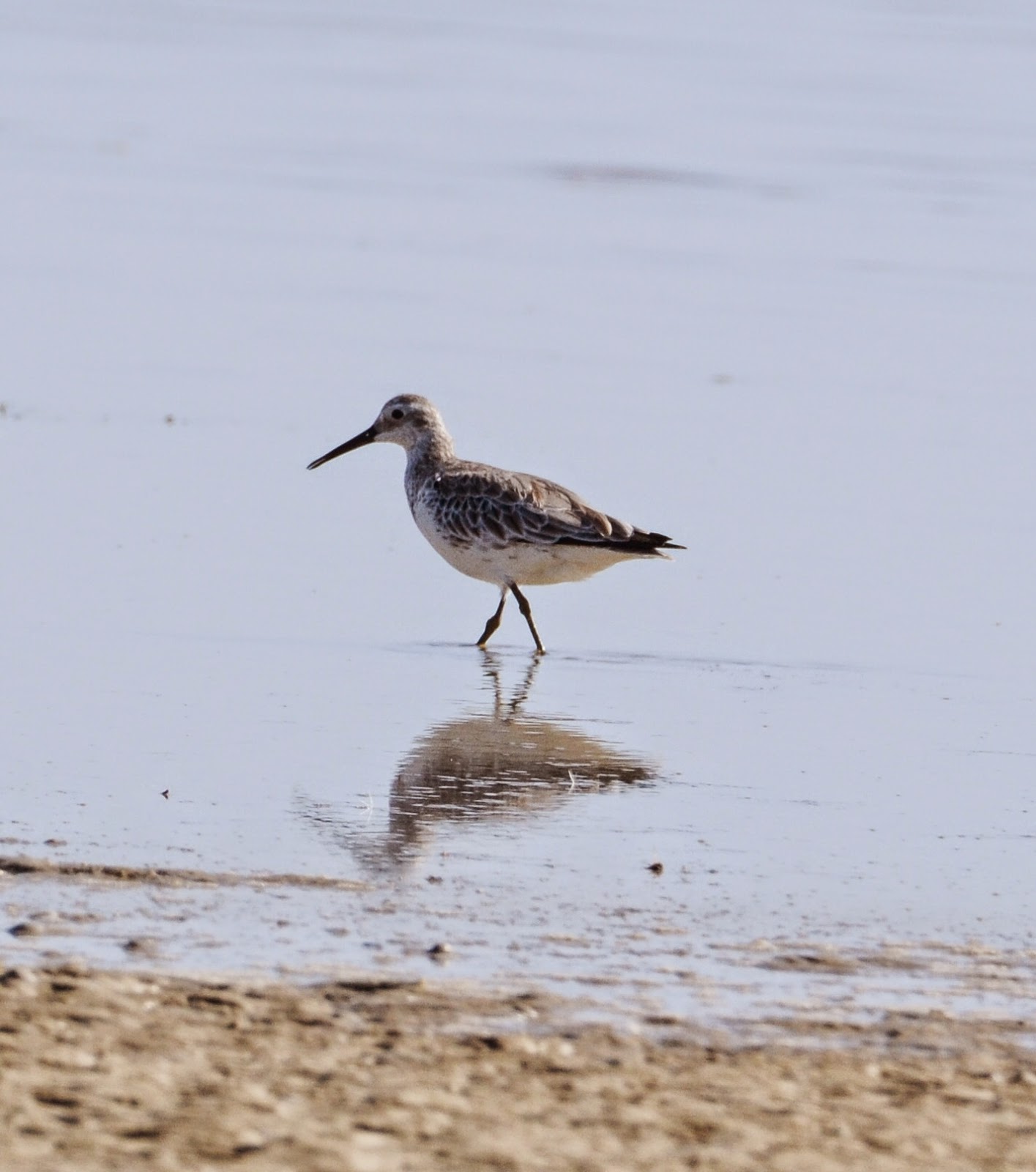
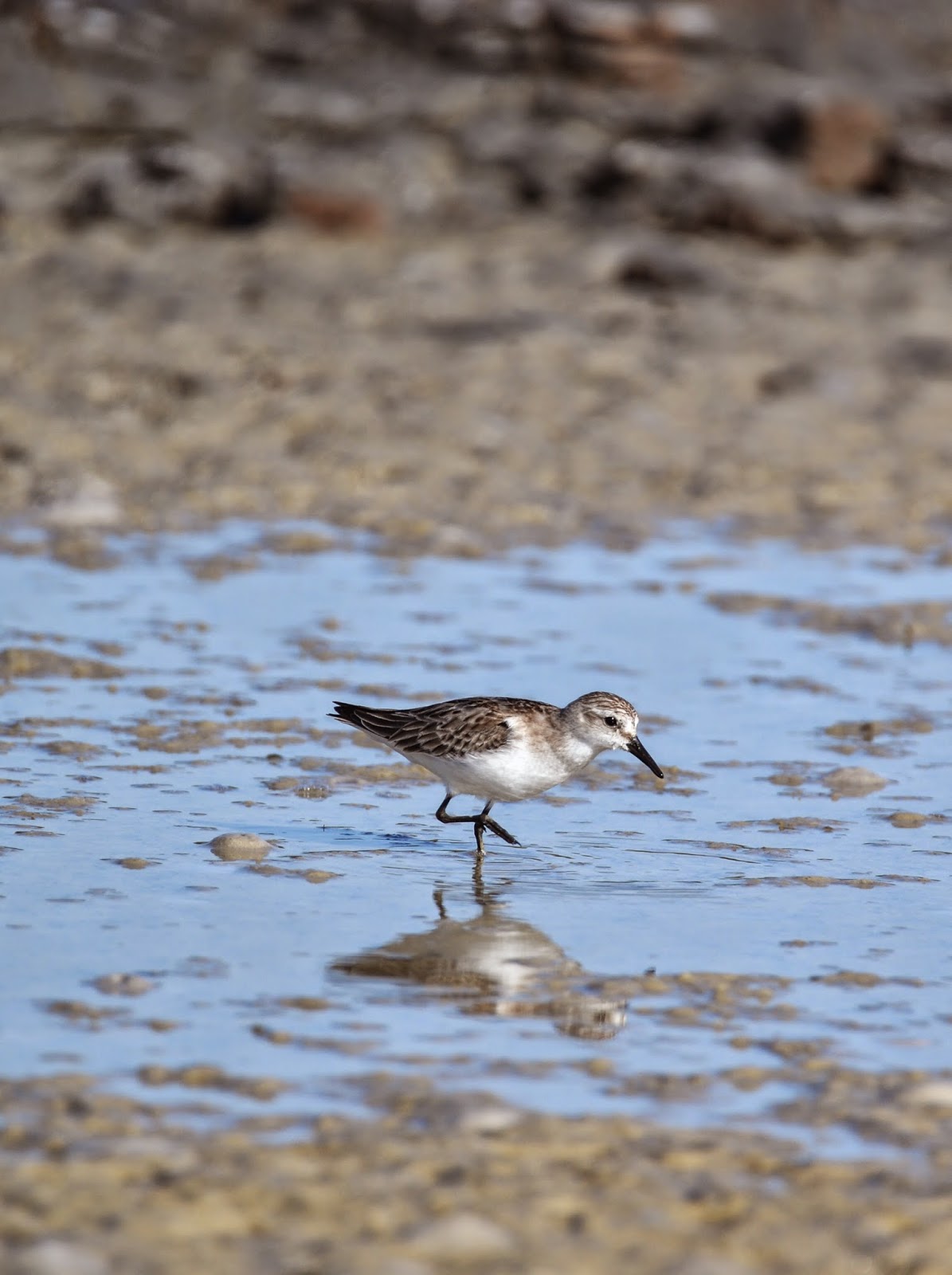
I decided to head down to Mandurah on Sunday afternoon to search for some of the waders to add to my "life list." It was the first hot day of the season with the mercury reaching 37 degrees. The tide was out at Nairns and scattered across the mudflats were couples and trios dragging their buckets and carrying their crab nets. Further off, boats sped through the deeper channels of the inlet. Ospreys flew overhead and a small pod of Pelicans preened in the distance. At the water's edge were a few groups of waders. Most notable were the Red Knots, Great Knots, Grey Plovers and, of course, the Red-necked Stints. The Stints were bathing and feeding in small pools alongside Red-capped Plovers. They looked quite refreshed and spritely, unlike the Knots who were more subdued and intent on feeding, having, no doubt, just flown in.

Before heading to Coodanup Reserve, I did some wading myself over to Creery Island. The water was knee-deep so it didn't pose much of a challenge. The island held onto many of it's secrets under the beating sun. I followed a Common Greenshank around the waterline who ensured I maintained a respectful distance. My camera began to heat up so I paused whenever I found patches of shade, and during one of these moments, a Buff-banded Rail trotted out of the low scrub to the water line. When it saw me, it froze, turned, froze again and then returned quickly into scrub. Splendid Fairy-wrens and Ospreys complained at my presence. Eventually, I lost sight of the Greenshank as it faded into the horizon and turned back to the mainland.

The tidal flats were sublime as the sun sank away and they provided great views of the waders. As I watched these unassuming holidaymakers, I couldn't help but feel a sense of awe at how far they'd come and how lucky we are that they choose our place each year. Maybe these migrations are just as miraculous as Aristotle's alternate theories.


Red-necked Stints


http://www.uh.edu/engines/epi2228.htm

http://www.npwrc.usgs.gov/resource/birds/migratio/ideas.htm


Friday, 7 November 2014

Payne's Find Salt Lakes

Down Maranalgo Road just out of Payne's Find is a series of salt lakes Frank O'Connor mentions on his Western Australian Birding website. If you want to see Orange Chats, this is, apparently, the place. I stopped here on my way back to Perth after a few days of birding in station country further north.

This might literally be the "middle of nowhere." And being alone in the middle of nowhere is exhilarating. The feeling is an odd combination of awe, privilege, freedom, stupidity and fear all at once. I'm struck by a sense of my own insignificance but also of a primordial belonging to the land.

Although it was September, the weather was blustery and cold with scattered showers: not exactly ideal 'chatting' weather.

A local at the Payne's Find tin shed which served as a cafe, servo, tourist centre, pub and motel, had tried to scare the "blow in" (me) by loudly announcing to the woman behind the counter that there was a "bad cyclone coming" then added "behave yourself" as he walked out the door. If a cyclone really was on the way, I suppose she had no option but to behave herself. I hardly think that's the time to spray paint swear words on the road or do some circle work in her ute.

As a side note, and having spent a few years in the country myself, country folk do spend a lot of time telling women to "be good" or "behave" which is a bit rich considering most of the bad behaviour I witnessed was by men. And what's worse, these cautionary words are often accompanied by a wink, adding a sexual undertone, as if the woman, at a moment's notice, would be engaging in some sort of sexual impropriety. I know I've often thought, "I'm just popping down to the co-op for some milk and eggs but I think I'll stop for some naughty business in the breakfast cereal aisle. If only someone would tell me to behave, I might be able to control myself."

But I digress. Luckily, I had seen the weather report the night before and was not so easily fooled. It didn't bode well for sighting the Orange Chats and I wasn't surprised not to see any. Even so, there were plenty of other birds braving the elements: flocks of ducks and avocets on the lake as well as a lovely Yellow-billed Spoonbill couple who were obligingly perched on a fantastic dead tree.


A lone Bungarra dug in the sand around the lake creating trenches and holes that made it treacherous to walk around; especially if, like most birders, you are focused on more important things than where you are stepping. I thought it might be looking for buried eggs or perhaps grubs. Either way, it was very industrious. In fact, it seemed like the Bungarra and I were the only ones involved in any activity.


A large flock of Pink-eared Ducks and a smaller flock of Pacific Black Ducks shifted to the far end the lake as soon as I arrived but the Red-necked Avocets weren't bothered by my presence at all so I was able to snap a few good shots of them.  I also saw a juvenile Red-kneed Dotterel who was methodically making it's way around the water's edge, head down, searching for tasty invertebrate morsels. Previously, I'd only seen an adult from a great distance at the Esperance Golf Course so I was delighted to have a close view of this youngster.


This is a great birding spot. A half day in better conditions would allow for a more thorough look around, so next time let's hope the weather takes the local comedian's advice. 


Sunday, 2 November 2014

Penguin Island

On Sunday afternoon, we took the very small ferry to Penguin Island for a birding adventure. This little island in Shoalwater Bay is home to thousands of birds including about two thousand of its namesake. It's a breeding sanctuary for Little Penguins as well as Silver Gulls, Pied Cormorants and Australian Pelicans. But don't expect to see any penguins there - at least not in the wild. This is an unlikely pleasure afforded to few. They are out all day and only come back once the tourists have gone. As a consolation, there's a show you can see starring some rescue birds in the Discovery Centre but unfortunately, as is common knowledge in the birding world, "showbirds" cannot be lifers.


So we ignored the show and set off around to the left of the island to see what we could find. Being spring, there were hundreds of juvenile gulls around and we marvelled at how ugly they were in that awkward in-between stage - kind of like teenagers with bad hairstyles and a lot of whining. I was detecting some parallels in my own life (having recently raised two teenagers into adulthood) when I noticed something interesting. In response to the persistent nagging of the youngsters, the parent gulls would get very testy and angrily squawk at them. I'm afraid to say I took some pleasure in watching this. The juveniles then bid a hasty and fearful retreat; clearly being forced to develop some independence. Hmm...


As we walked further around the island, we saw the newly hatched chicks which were, unexpectedly, rather gorgeous. They were spotty little brown balls on legs that resembled plush giraffes more than any bird. Their parents defended them ferociously, screeching at anything that moved within a few meters of them. This made walking along the narrow, rocky stretch of beach awkward and nerve-racking and I started to see things from the juvenile's perspective. Next I would be rolling my eyes!


I'd read that the Bridled Terns were back on the island and wanted to get my first shot of these photogenic birds. We saw quite a few pairs, much to my delight, and some that seemed to be nesting. These are the loveliest of the terns and will let you approach to within a few meters of them if you are behaving sensibly. Trying to get a shot of one in flight is a different story though because they zip around like swallows, and I found them quite inconsiderate in this regard. So I recommend putting the camera down and enjoying their loveliness with the naked eye. Nonetheless, they were the highlight of my day.


While resting for a moment below a chaotic pelican nursery, a kind stranger pointed us in the direction of a pair of young penguins. We couldn't believe our luck! They were in a little hole in the rocks, not 10 meters from where we sat, no doubt waiting patiently for the tourists to leave the island so their parents could return with their dinner. Luckily, my 150-600 Tamron means I don't need to get too close to any bird and I joyfully took a few snaps of them without much disturbance.


A stroll back to the jetty revealed plenty more gulls, some Crested Terns and a pair of regal-looking Caspian Terns. A pair of Fairy Terns also flew overhead and an Eastern Osprey disappeared into the distance with a sizeable fish in its clutches. Feeling very satisfied with ourselves and our great sightings, we sat in the shade to wait for the ferry.


We were met with a mild panic on the jetty as people did the maths. A lot of people and a small ferry meant some would be left behind. And sure enough, as the captain walked down the line counting the hopeful passengers, his arm came down - just behind us. There were some exclamations and worried faces. How would they get to the mainland? Would they have to walk across the sandbar in waist-deep water? Or spend the night on the island? Would the penguins arriving back from a long day at sea be as hostile to them as the seagulls were to us? The wind was picking up and the air had a chill to it that didn't bode well for a night in the open with some irritable wildlife. But I couldn't concern myself with their fate. We had made it onto the ferry and we were the lucky ones. I'm not sure what became of the rest. They probably caught the 4.10 ferry instead.


Friday, 31 October 2014

Flying Over the Cuckoo's Nest

Birding is all too often considered the glamour sport of the Australian elite: exotic locales, clandestine meetings and intoxicating chases. And while it's difficult to surpass the lingering afterglow of a 'lifer' or the heady thrill of a rare sighting, especially when steeped in congratulatory praise of the birding peerage, it's worth remembering that the sport is not all glory and accolades.

The birder lives a life of sacrifice. Loved ones are shunned in favour of an eBird notification. Weekend to-do lists are abandoned and gardening is forsaken. Fashionable clothes are replaced with sensible shoes and camouflage gear designed for comfort rather than style, seemingly over a brief period in the 80s. The 1880s. Logical itineraries and practicalities such as 'closest toilet' are ignored. Friends are no match for like-minded enthusiasts who possess the subtle but mercenary competitiveness necessary to survive in this bird-eat-bird world.

It's a life of disappointment. Bitter disappointment. Imagine driving 600 kilometres, sitting alone in the middle of a deserted national park, eating cereal out of a ziplock bag and whistling for hours on end in biting wind for a bird that never comes.  At least, a bird that never comes for you.

And then there are the risks. Neck strain and grazed knees are the tell-tale signs of the birder whose eyes are in the treetops. Dangerous and often snake-infested terrain is traversed (think Herdsman in October). Questionable but potentially knowledgeable locals at outback outposts are befriended in spite of cautionary tales such as 'Wolf Creek'. Signs like 'no shooting past this point', 'no fuel for 500kms' and 'most western pub' are pointed reminders of extreme isolation in a very vast land.

Of all the difficulties of birding, perhaps the most significant is the inevitable personality disorder that results from the intense nature of the sport. Ever-alert to the possibility of a sighting, the sound of a chirrup or the flash of a wing, even simple acts such as driving down the street to the shops or having a conversation outdoors become ordeals.  For the birder exists in a heightened sensory state which is exacerbated in an alfresco setting. Study her closely and you will note the rapid eye movements, distracted mental state and ears trained to notice the softest trill hundreds of meters away. Such finely-honed skills of observation can offer the birder no peace.

But in spite of the misconceptions, drawbacks and dangers, the birding life is a life lived well and full. And here's the proof: